Hunting note
Start with the decision, then inspect the details.
A specification-led comparison of white oak and red oak for furniture: Janka hardness, shrinkage, decay resistance and pore structure, and what each figure means for a dining table, a chair or a bathroom vanity.
Most furniture listings say "oak" and stop there. That single word covers two different wood groups with different hardness, different movement, and — most importantly for furniture you plan to keep — very different tolerance for moisture. The difference rarely shows up in the showroom. It shows up two winters later, as a table top that has opened a seam or a vanity edge that has gone grey around the sink.
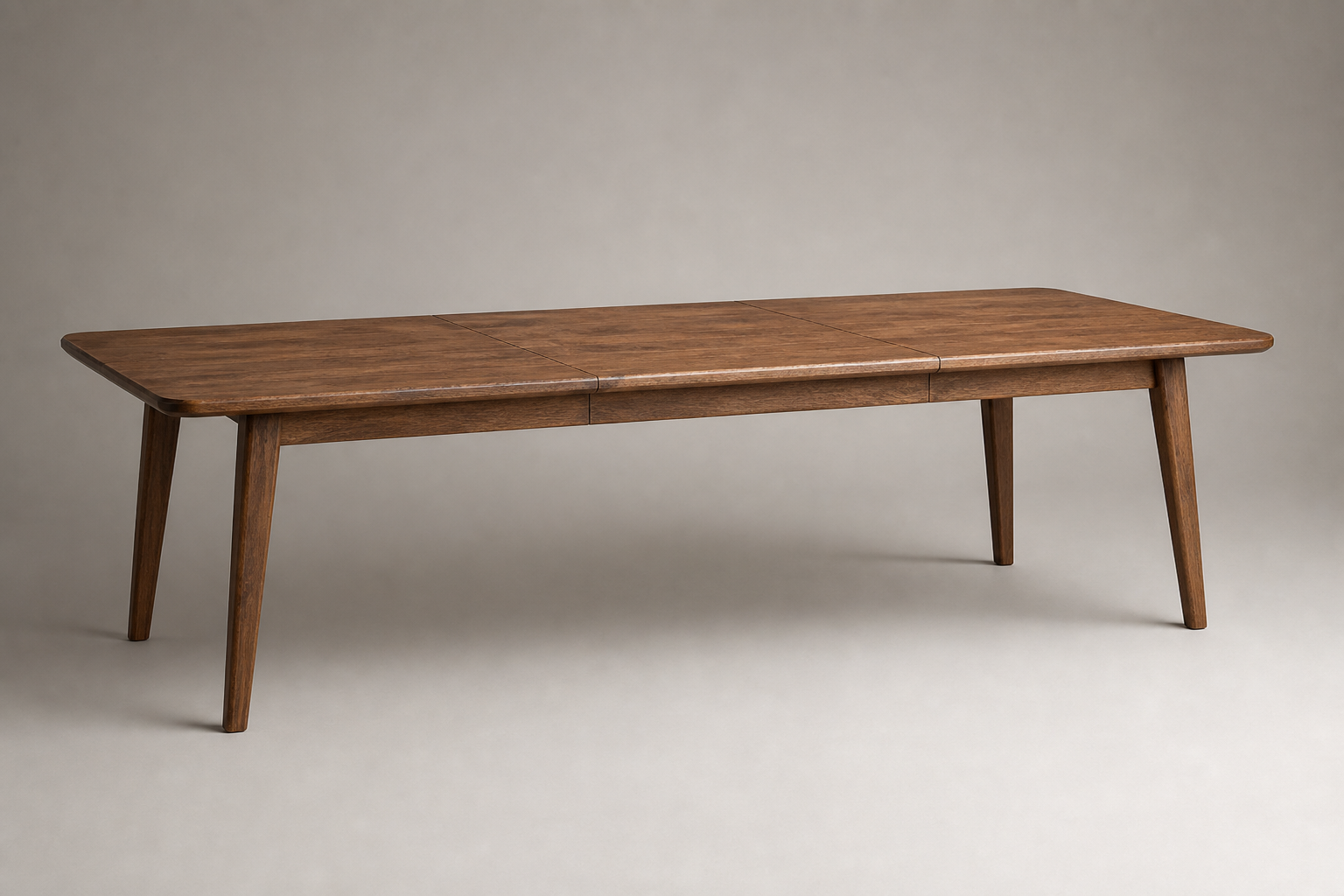
This guide sticks to the specifications you can actually check: hardness, density, shrinkage, decay resistance, and pore structure, plus what those numbers mean for a <a href="/products/article-seno-71-dining-table-walnut/" class="product-inline-link">dining table</a>, a chair, or a bathroom cabinet.
How the figures were checked: all measurements below come from the Wood Database species entries for white oak (Quercus alba) and red oak (Quercus rubra). Hardness, specific gravity, and average dried weight are given at 12% moisture content; shrinkage figures are green-to-oven-dry radial and tangential percentages.
The short answer
| Property | White oak (Q. alba) | Red oak (Q. rubra) |
|---|---|---|
| Janka hardness | 1,350 lbf | 1,220 lbf |
| Specific gravity | 0.60–0.75 | 0.56–0.70 |
| Average dried weight | 47.0 lb/ft³ | 43.8 lb/ft³ |
| Shrinkage, radial (green to oven-dry) | 5.6% | 4.0% |
| Shrinkage, tangential (green to oven-dry) | 10.5% | 8.6% |
| Decay resistance | Very durable | Non-durable to perishable |
| Typical price position | Slightly higher | Slightly lower |
For a dry, adult living room, both woods are perfectly serviceable. The gap opens up wherever water, humidity swings, or heavy daily scrubbing enter the picture — kitchens, bathrooms, mudrooms, rental turnovers.
Hardness: the number that gets quoted too often
Janka hardness measures the force needed to push a 0.444-inch steel ball halfway into the side grain of a sample at 12% moisture content. White oak rates 1,350 lbf and red oak 1,220 lbf — roughly an 11% difference.
Practically, that is small. Both are hard domestic hardwoods, and neither will dent from a dinner plate. Dents in real furniture come from concentrated impact (a chair leg dropped on a table top, a cast-iron pan set down hard), from thin veneer over a soft core, and from a finish that never cured properly. If a seller is leaning hard on a hardness number, ask what is under the surface instead.
Where hardness does matter is edge wear: chair legs, table aprons, drawer fronts, and the front edge of a desk. On those parts the heavier, harder white oak holds a crisp profile slightly longer. Machinability is not the trade-off you might expect, either — the Wood Database notes that oak, alongside other domestic hardwoods, "scored near the very top in an assessment of the machinability of domestic hardwoods." Sharp tooling matters more than species here.
Movement: the more useful measurement
Shrinkage is where the two woods genuinely separate. White oak moves 5.6% radially and 10.5% tangentially; red oak moves 4.0% and 8.6%. Tangential shrinkage is the change across the growth rings — the direction that opens seams, cups wide boards, and makes a breadboard end proud of its panel.
In plain terms, a wide white-oak top will move more across the season than a red-oak top of the same width. That is not a defect, but it changes what you should look for. On a wide top — a <a href="/products/article-conan-75-oval-dining-table-walnut/" class="product-inline-link">dining table</a>, a long console — ask how it is built: narrow edge-glued strips with alternating grain, breadboard ends that are pinned rather than glued, or a veneered substrate — solid wood and engineered wood are built differently, and the difference matters most on wide tops. A single wide slab of either species needs a base that lets it move. When a white-oak piece is built with the same allowance as a red-oak piece, the white-oak version will often be the first to show a hairline seam.
Also worth knowing: quartersawn boards shrink less across the width than flatsawn boards of the same species, which is why quarter sawn and rift sawn stock carries a premium in both oaks.
Water and decay: where the two really diverge
This is the decisive difference for furniture that lives near water.
White oak is "rated as very durable" and is "frequently used in boatbuilding and tight cooperage applications" — barrels, in other words. Red oak is "rated as non-durable to perishable, with poor insect resistance," and it "can become discolored and stained when in contact with water, particularly in the porous growth ring areas."
Translation for furniture buyers:
- Bathroom vanity or a kitchen island with a sink: white oak. A red-oak top will stain and grey where water sits, especially at the end grain and around the sink cut-out.
- Mudroom bench, boot tray shelf, plant stand: white oak.
- Dining table in a dry room, wiped with a damp cloth: either species is fine, provided the finish is intact.
- Anything permanently outdoors: neither, unless the piece is explicitly built and finished for exterior use. Furniture-grade interior oak, whatever the species, is not an outdoor material.
Colour, pores, and what your finish will look like
These are species groups, not finishes. White oak is light to medium brown, "commonly with an olive cast," while red oak heartwood is light to medium brown "commonly with a reddish cast." A white-oak piece can be stained dark walnut and stay white oak; a red-oak piece can be bleached pale and stay red oak. Colour is a showroom clue, never proof.
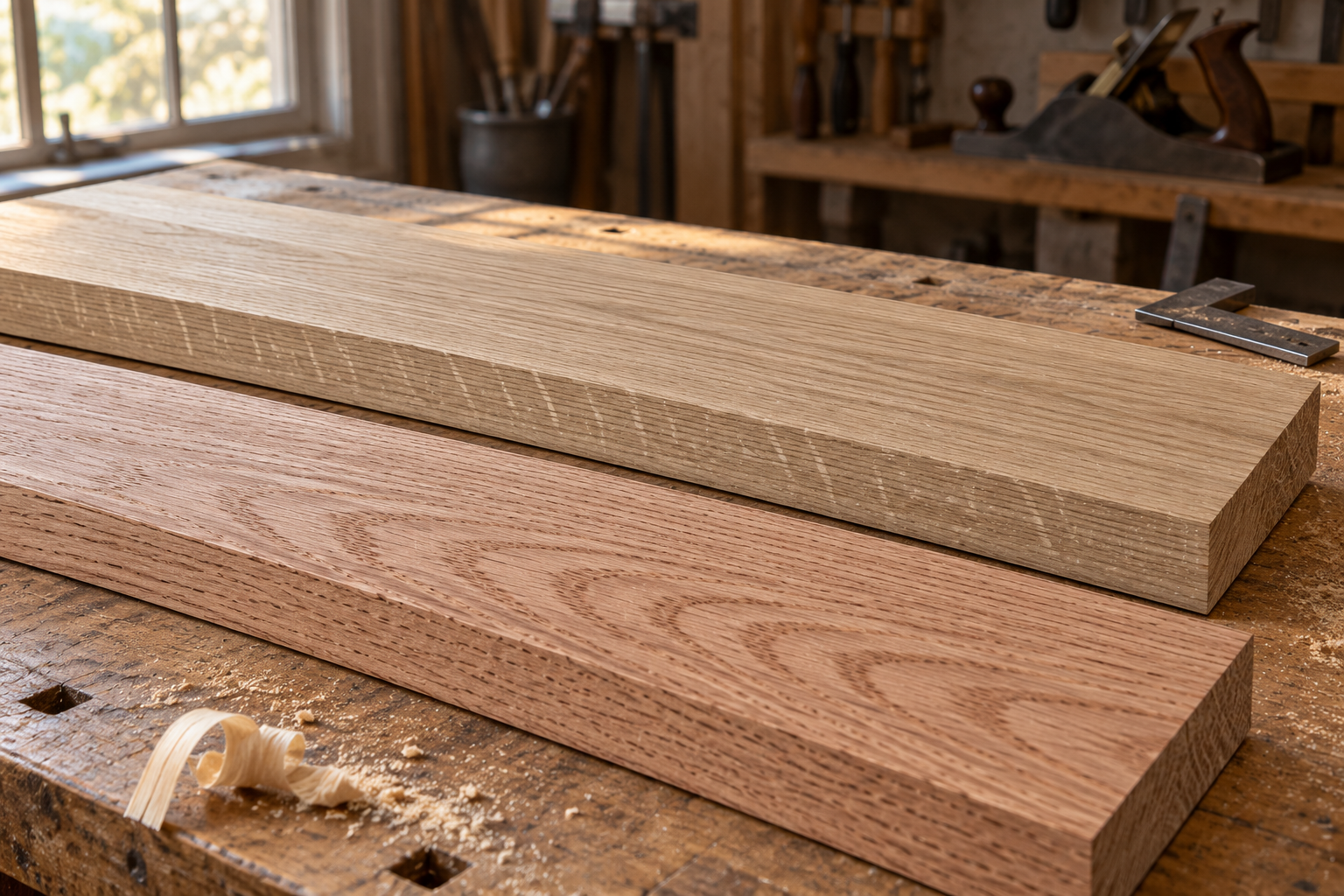
The pores are the more reliable tell. Red oak is famously open-pored: "the pores are so large and open that a person can blow into one end of the wood, and air will come out the other end — provided the grain runs straight enough." White oak's earlywood pores carry abundant tyloses, the small bubble-like structures that block them, while red oak's are "absent or scarce." White oak's rays also tend to be taller on the face grain — sometimes exceeding an inch, against "rarely exceeding one inch" for red oak.
Finishers generally find that this shows up in the surface: thin finishes telegraph open pores, so red oak usually needs grain filling before a smooth film finish, while white oak reads more even under oil or paint. If the look you want is texture-forward, the open red-oak grain is the more dramatic of the two.
Five checks that separate them in a showroom
1. Ask for the species, not the common name. "Oak" is not a species. A serious maker or retailer can name Quercus alba or Quercus rubra, or at least say "white oak" versus "red oak" on the spec sheet.
2. Look at an unfinished surface. Underside of a seat, inside a drawer, back of a headboard. Red oak reads warmer and slightly pink; white oak reads greener and more neutral.
3. Check the end grain. Red oak's earlywood pores are wide open; white oak's are plugged. A phone light and a close look at a leg bottom is usually enough.
4. Look for ray fleck. Long, thin, shiny ribbons on a quartersawn surface point to white oak more often than red oak.
5. Weigh it in your hands, not on a spec sheet. The 47.0 versus 43.8 lb/ft³ difference is real but small on a <a href="/products/article-portima-c-side-table-walnut/" class="product-inline-link">side table</a>. It is noticeable on a full dining table, and it is no substitute for checks 1–3.
Refinishing, dust, and when to call a pro
Oak is pleasant to finish and unpleasant to sand carelessly. Both species throw fine dust when stripped or sanded, so work with extraction or a proper respirator rather than a paper mask, and keep solvent strippers and film finishes away from pilot lights, open flames and unventilated rooms. Water-based finishes dry faster and smell less; oil-based finishes amber the wood and need longer between coats. Either way, a fresh film finish off-gasses while it cures. Water-based products carry a lower VOC load than solvent-based ones, but "low VOC" is not "no VOC": give a refinished piece a few days in a ventilated room before it goes into a bedroom or a small flat, and keep children and pets off it until the surface is fully hard.
Water damage is the other place to know your own limits. A plain water ring or a lifted finish is a weekend job: fine abrasive, then a fresh coat. Black staining that has gone into the wood, a soft or swollen edge, or a seam that has opened across a glued-up top means moisture has travelled further than the surface — that is the point to call a pro. A furniture restorer or carpenter can dry, re-glue and re-flatten the piece; sanding a swollen top flat without fixing the cause usually just moves the problem to next winter. Red oak stains more readily on contact with water, so a red-oak vanity that has already greyed around the sink is worth a proper assessment rather than another coat of oil.
Price and availability
Both species are "abundant" in a good range of widths and thicknesses, flatsawn and quartersawn. White oak is "usually slightly more expensive than red oak," and in both species "thicker planks or quartersawn boards" carry a further premium.
So a white-oak premium is normal — but it should be a modest one. If the gap is large, you are usually paying for quartersawing, width, or the maker's joinery rather than the species itself. Ask which surfaces are solid and which are veneered; a veneered panel can legitimately use either species, and the species on the label then describes the face, not the structure.
Which one for which piece
- Dining or desk top in a dry room: either. Choose white oak for a quieter grain and better water tolerance at the edges; choose red oak to spend the difference on joinery or size. If you are still comparing species, the same trade-offs decide whether a walnut dining table is worth buying and how stone tops hold up against water and heat.
- Chairs, stools, bed frames: either. Both clear the hardness needed for legs and stretchers; check the joinery and the finish, not the Janka number. On a heavy piece, ask what the base and fixings are rated for: a solid white-oak top is the heavier of the two, and weight capacity belongs to the frame and the hardware, not to the species name on the label.
- Bathroom vanity, kitchen island, sink surround: white oak.
- Painted furniture: red oak if you are grain-filling anyway, white oak if you want a smoother painted surface with less prep.
- Wide plank tops: either, but insist on a construction detail — narrow strips, breadboards, or a proper substrate — because both species move.
- Flooring and trim: red oak is the familiar budget choice; white oak is the more water-tolerant one.
The bottom line: pick white oak when the piece will meet water, when you want a calmer surface under oil or paint, and when you are willing to pay a small premium for durability. Pick red oak when the piece will live in a dry room and you would rather put the money into joinery, size, or finish quality. Either way, buy the construction, not the species name — "oak" on a label tells you almost nothing until you know which oak, how it was sawn, what is solid, and what is veneered.
FAQ
Is white oak always more expensive than red oak?
Usually, but only "slightly" at the lumber level. The bigger price variables are thickness, quartersawing, and the maker's construction. A red-oak table with good joinery is a better buy than a thin white-oak table with a stapled frame.
Is red oak low quality?
No. Red oak is a hard, abundant domestic hardwood at 1,220 lbf Janka. Its weakness is moisture and decay resistance, not strength. Keep it dry and finished and it will outlast most of the furniture around it.
Can I mix white oak and red oak in the same room?
You can, but they read differently under the same finish: red oak warmer and more open-grained, white oak cooler and tighter. In one sightline, most people notice. Mix freely across rooms, and be deliberate within a single room.
Will oak furniture dent easily?
Not from normal use. Dents come from concentrated impact and from thin veneer over a soft core. Ask what the substrate is on any large panel.
Is quarter sawn oak worth the premium?
If you want stability across wide boards and visible ray fleck, yes. Quartersawn stock shrinks less across the width and moves more predictably, which matters most on table tops and <a href="/products/ikea-ivar-cabinet-black-mesh-63/" class="product-inline-link">cabinet doors</a>.
Sources: Wood Database — White Oak, Wood Database — Red Oak. Hardness, specific gravity, and dried weight at 12% moisture content; shrinkage as green-to-oven-dry percentages.