Hunting note
Start with the decision, then inspect the details.
A practical guide for homeowners and renters researching furniture purchases online on rattan vs wicker vs cane difference, covering the best next steps, tradeoffs, and when to call a pro.
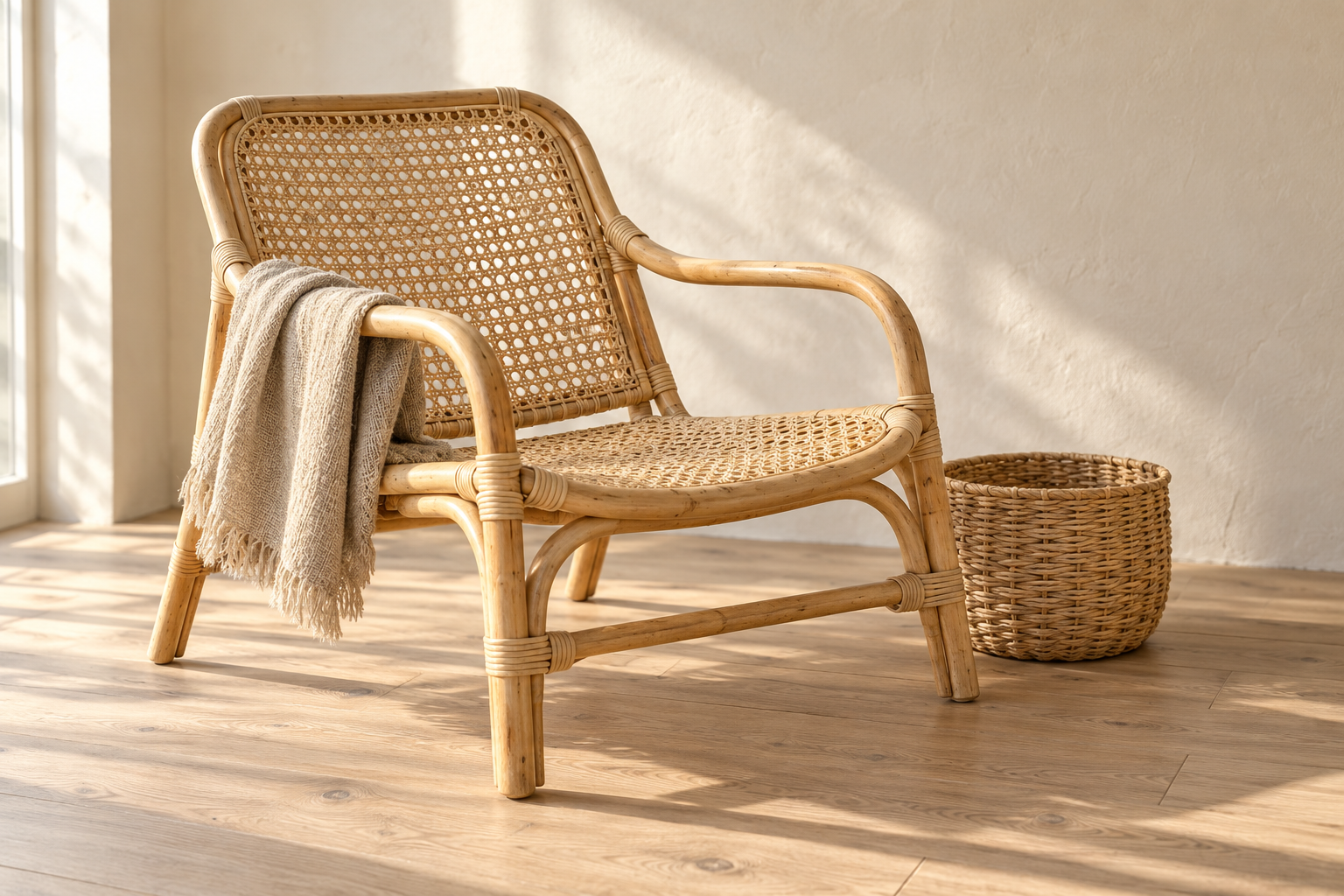
Rattan, wicker and cane are not three competing materials. Rattan is a climbing palm. Wicker is a way of weaving. Cane is rattan cut into thin strips and used for seats, backs and bindings. A single chair can be all three at once — a rattan frame, a wicker weave, a cane seat — and most product listings still treat the words as if they were interchangeable. They are not, and the difference tells you how the piece was built, how much it weighs, how it will age and whether it can be repaired.
This guide is research-based, not a lab test. We read the material and craft definitions in the sources listed at the end, then translated them into the questions worth asking before you pay for a piece. Where the sources do not support a claim — flexural strength, expected service life, UV resistance of a specific finish — we say so rather than inventing a number. The care label and the manufacturer's own documentation always override general guidance.
The short answer
- Rattan is the plant: roughly 600 species of Old World climbing palms, harvested mainly in Southeast Asia, with a solid stem that holds a nearly constant diameter.
- Wicker is the technique: weaving pliable material — rattan, willow, reed, bamboo, paper cord or synthetic filament — over and around a frame.
- Cane is prepared rattan: the outer bark peeled into narrow strips, or the core split into strands, used for woven seats and backs. Caning is the craft of applying it.
So the useful question is not "rattan or wicker?" It is: what is the frame, what is the weave, and what is the seat? Those three answers decide almost everything else.
Rattan is a plant, not a style
Rattan is the name for roughly 600 species of Old World climbing palms in the subfamily Calamoideae, with the greatest diversity in the closed-canopy tropical forests of Southeast Asia. Because rattans are palms and not woody trees, they do not branch and do not produce secondary growth. That single botanical fact has a practical consequence you can see in the furniture: the stem's diameter is essentially fixed for the life of the plant, typically around 2–5 cm (¾–2 in).
That is also why rattan poles read as consistent, straight-ish stock rather than as sawn timber with growth rings. There is no wide board to be cut from a rattan stem, no quarter-sawn face, no grain pattern that changes with the saw. What you get is a round or peeled pole of a given diameter, bent and joined into a frame.
Two more details matter when you are judging construction quality:
1. Rattan is solid, not hollow. Bamboo — often mistaken for rattan because both are pale, round and jointed — is hollow. Rattan is a solid, flexible vine that climbs using thorns to hold onto surrounding trees, and it needs support to reach the canopy. Because the stem is solid it can be softened with heat, bent and joined into curved frames, so a bend reads as a continuous member rather than an assembled corner. Whether a particular bend will carry a particular load is a structural question this guide does not answer — ask the maker, or keep the load modest.
2. Almost all rattan is still wild-harvested. Despite decades of attempts at commercial cultivation, most rattan products come from wild plants, and supply is under pressure from deforestation and overexploitation. Provenance is therefore a real question, not a marketing footnote. If a seller cannot say where the material came from or whether it is certified, treat the sustainability claim as unverified.
Wicker is a technique, not a material
Wicker is a method of weaving used to make furniture and baskets, and it is described as the oldest furniture-making method, documented as far back as roughly 3000 BC in ancient Egypt. The word describes the weave, not the substance: traditional wicker uses willow, rattan, reed or bamboo, and modern wicker also uses paper-based cord and synthetic fibres.
This is the source of most of the confusion in listings. "Wicker" tells you a weave exists. It does not tell you what is woven. Two chairs that both say "wicker" can be completely different products:
- Natural wicker — plant material woven over a frame. Light, stiff enough for seating, and, as the reference literature notes plainly, in need of maintenance. In trade practice plant fibre takes on and gives off moisture with the room, and a damp spell is what invites mildew; that is experience rather than a measured result, and it is the reason natural wicker wants a dry, covered spot.
- Resin or synthetic wicker — extruded polymer strands woven in the same patterns. It is the version sold for outdoor use, which is why an "all-weather wicker" set is normally resin over a metal frame. It is also the version that cannot be sanded, glued or re-caned the way plant material can.
In furniture, the usual build is a stiffer frame — hardwood, rattan poles, metal — with the more pliable material woven into it. Wicker's reputation for being light yet sturdy comes from that combination, and it is why the technique shows up so often on porch and patio furniture that gets moved around.
Cane is rattan cut thin — and caning is a specific craft
Caning is the craft of applying rattan cane or rattan peel to furniture, typically the backs and seats of chairs. It is distinct from wicker, even though both involve weaving rattan-family material. In practice, the cane used for furniture comes from rattan vines native to Indonesia, the Philippines and Malaysia. The vines can reach 30–90 m (100–300 ft) in length, most with a diameter under about 25 mm, and before export the stems are cut to uniform lengths and the bark is removed in narrow strips of roughly 2–5 mm (1/16–3/16 in).
Those strips are why cane seats look the way they do. Thin, consistent, slightly glossy strands can be woven into open geometric patterns that flex under load, breathe in heat and let a chair look light without being flimsy. The trade-off is exposure: a cane seat is a grid of thin strands under a person, and it fails at the strand, the binding or the frame edge — not in the middle of a solid panel.
One clarification worth keeping: sugar cane and the American use of "cane" for bamboo are unrelated to furniture cane. If a listing says "cane" and shows a hollow, jointed, bamboo-like pole, it is describing something else.
Why listings blur all three
The words get mixed because each one is shorthand for a different layer of the same object, and because "rattan" has become a style signal rather than a material claim. A few patterns are common enough to check for:
- "Rattan-look" usually means extruded plastic or resin strand, or paper-wrapped wire, over a metal frame. It can be a good outdoor product; it is not rattan.
- "Wicker" on an outdoor set is frequently resin weave rather than plant material — check, because the label alone will not tell you.
- "Cane back" describes the seat or back panel, not the frame. The frame may be beech, ash, rubberwood or rattan.
- "Natural finish" describes colour, not species or provenance.
None of this is automatically dishonest — but it means the material noun in a title is the weakest evidence in the listing. The construction details are stronger.
What each construction means for strength and repair
Reasoning from the material properties above gets you most of the way:
- Solid rattan pole frames are bent and joined rather than sawn, and they can be re-wrapped, re-bound and re-glued. Joints — wraps, dowels, screws, brackets — are the usual weak point, so check them by hand.
- Woven panels distribute load across many strands. They are strong in tension and weak against a single point: a knee, a heel, a pet's claws. Once a strand breaks, the neighbours carry more and the failure tends to spread.
- Cane seats are often repairable, but repairability depends on the pattern. In trade practice hand-woven strand cane can be redone, and pre-woven cane webbing is usually replaced as a sheet; ask a chair caner before assuming a pressed panel can be saved.
- Resin weave does not need feeding or oiling, and it also does not refinish. If a strand is cut, the repair is usually a cosmetic patch rather than a structural one.
If the frame is engineered wood rather than solid stock, the frame's moisture behaviour and screw-holding become the limiting factor long before the weave does. That comparison is worth reading on its own terms.
Moisture, sun and the indoor/outdoor question
The material definitions explain the outdoor advice better than any care slogan:
- Natural rattan and cane are plant material. They take on and give off moisture, which means they move. Prolonged damp is the enemy: it invites mildew in the weave and can soften glue lines. Direct sun plus dry indoor air is the other extreme and can make thin cane brittle. A covered porch is a kinder environment than an exposed patio.
- Resin wicker is built for weather. How long a given strand resists sun and heat is product-specific and outside what these sources cover. What you can inspect is the frame underneath: a chipped coating is where rust starts, not in the weave.
- Wicker's own reference description is blunt: natural wicker requires maintenance. That is not a defect; it is the maintenance schedule you are signing up for.
Practical rule: if the piece will stay outside through rain and winter, buy the version designed for it and judge the frame and fixings first — our patio buying guide walks through that checklist. If it lives indoors or on a covered porch, natural materials are viable — with the understanding that you are now maintaining them. For a single outdoor seat rather than a set, compare frames and weave types in our outdoor <a href="/products/article-gabriola-34-lounge-chair-ivory-boucle/" class="product-inline-link">lounge chair</a> guide.
How to read a product listing before you buy
A short, honest checklist that filters most of the noise:
1. Ask what the frame is made of — solid hardwood, rattan pole, metal, or engineered wood. This is the structural answer.
2. Ask what the weave is made of — plant strand, paper cord, or resin. This is the weather answer.
3. Ask what the seat is — cane, woven webbing, upholstered, or solid. This is the comfort-and-repair answer.
4. Look at a close-up of a cut end or joint. Solid rattan shows a solid cross-section with a thin skin; wrapped foam or plastic shows a seam or a hollow core.
5. Check the weight and the fixings. A light piece is not automatically weak, but a light piece with small screws into thin material tells you its load ceiling.
6. Ask about provenance if sustainability is part of why you are buying it. "Rattan" alone does not answer that question.
Care and realistic repair
- Dust the weave with a soft brush rather than soaking it; water driven into tight weave takes a long time to leave.
- Wipe, then dry immediately. Do not leave plant-material furniture sitting wet, and do not store it damp.
- Keep it away from direct heat — radiators, space heaters, fireplaces. Thin cane and dry rattan are combustible, and heat also accelerates embrittlement.
- Re-tighten fixings once or twice a year. Loose joints concentrate load on fewer members and are the most common cause of a frame failure that looks sudden.
- Treat small splinters as a real hazard. Broken cane and rattan ends are sharp; sand or bind them before someone runs a hand along the edge.
- Do not overload. No stated load rating means no promise about load. Do not stand on woven seats, and do not use a decorative chair as a step.
Safety and limits
This is descriptive guidance, not a structural assessment of any particular product. Load capacity, finish safety, flame behaviour and weather resistance vary by manufacturer and are not inferable from the words "rattan", "wicker" or "cane". Buy the piece for the use it is rated for, follow its assembly and care documentation, and if a frame is cracked, a joint is loose or a woven seat is sagging, stop using it until it is repaired. None of the sources behind this article provide test data on strength, so treat any specific load or lifespan claim you see elsewhere — including from a seller — as something to verify rather than assume.
FAQ
Is wicker always made of rattan?
No. Wicker is a weaving method. It is made from rattan, willow, reed, bamboo, paper cord and synthetic fibres, and outdoor wicker is usually resin.
Is cane the same thing as rattan?
Cane is prepared from rattan — the outer bark peeled into strips, or the core split into strands — but "caning" specifically refers to the craft of weaving it into seats and backs. "Rattan" alone does not mean a cane seat.
Can rattan furniture be used outdoors?
Natural rattan and cane can handle a covered porch but not sustained wet. Fully exposed outdoor furniture is normally resin weave over a metal frame. Check the frame, the fixings and the finish, not just the weave.
Is rattan sustainable?
Most rattan is still wild-harvested, and supply is under pressure from deforestation and overexploitation. Certification and provenance claims need evidence; the material name alone does not prove responsible sourcing.
How can I tell solid rattan from plastic or wrapped foam?
Look at a cut end, a joint and the underside. Solid rattan has a continuous solid cross-section with a thin skin, and joints are wrapped or pinned rather than moulded. Wrapped foam or extruded strand usually shows a seam, a hollow core or a uniform plastic surface.
Does a cane seat hold as much weight as a solid seat?
It is a different structure: a grid of thin strands in tension rather than a panel. The sources here give no load figures, so use the manufacturer's rating and do not stand on it.
Sources
- Rattan — Wikipedia: roughly 600 species of Old World climbing palms (Calamoideae), Southeast Asian diversity, no secondary growth and constant stem diameter of about 2–5 cm, wild harvesting and supply pressure, non-timber forest product status.
- Wicker — Wikipedia: wicker as a weaving method and the oldest furniture-making method (c. 3000 BC), traditional materials including willow, rattan, reed and bamboo, synthetic and paper-cord versions, natural wicker maintenance requirement, frame-plus-weave construction.
- Caning (furniture) — Wikipedia): caning as the craft of applying rattan cane or rattan peel, its distinction from wicker, rattan vine lengths of 30–90 m, stem diameters under about 25 mm, bark strips of roughly 2–5 mm, and the solid-versus-hollow contrast with bamboo.
This article is research-based guidance, not hands-on testing. Material descriptions, care requirements and weather performance vary by product; check the specific item's documentation and care label before cleaning, exposing it to weather or loading it.