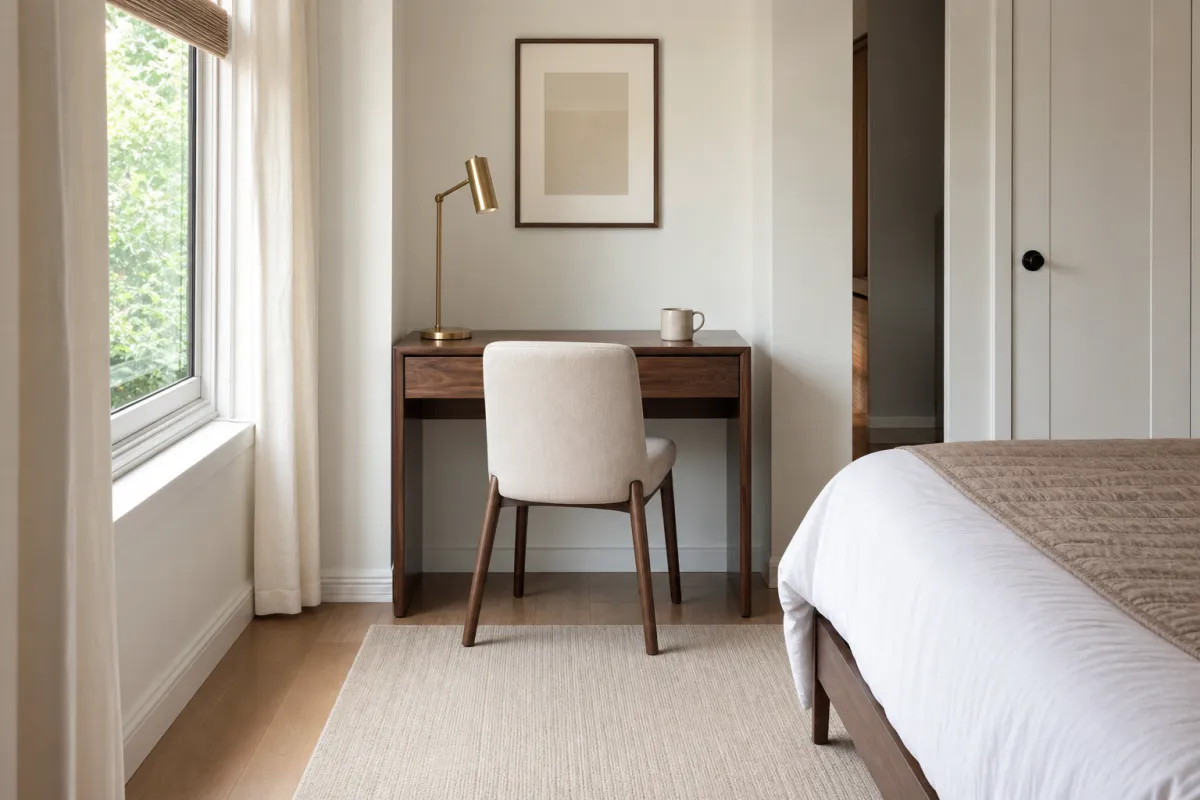
Hunting note
Start with the decision, then inspect the details.
A practical guide for homeowners and renters researching furniture purchases online on best writing desk for bedroom, covering the best next steps, tradeoffs, and when to call a pro.
The best writing desk for a bedroom is compact enough to preserve comfortable walking space, deep enough to support your daily work, and visually quiet enough that the room still feels restful. For many bedrooms, a desk approximately 36–48 inches wide and 20–24 inches deep provides the most useful balance. A shallow writing desk can work for journaling or occasional laptop use, while regular remote work usually demands more surface area, better cable management, and an ergonomic chair.
Do not choose by appearance alone. Before ordering, measure the desk location, nearby doors and drawers, chair clearance, electrical access, and the route from your building entrance to the bedroom. Then compare construction, weight capacity, return terms, and anti-tip provisions. A beautiful desk becomes a poor purchase if it blocks a closet, shakes while you type, or leaves too little room to pull out a chair.
Start by Measuring the Bedroom, Not the Desk
Mark the proposed desk footprint on the floor with painter’s tape. Include the desk’s full width and depth, then allow at least 30–36 inches behind it for the chair and normal movement. More space may be necessary if the desk faces a bed, sits beside a dresser, or shares a narrow walkway. Open every nearby door, closet panel, and storage drawer while the outline is in place. This simple test catches conflicts that product photos rarely reveal.
Measure vertically as well. A desk positioned under a window must clear the sill, handles, curtains, radiator, and any projecting trim. If it will sit beneath wall shelves, leave enough space for a monitor and task lamp without making the work area feel compressed. Also record baseboard thickness because it can prevent a desk from sitting flush against the wall. In a rental, note where existing outlets are located before committing to a layout that would require long extension cords.
Finally, measure the delivery route. Compare the packaged dimensions—not just the assembled dimensions—with the width of doors, hallways, stair turns, and elevators. Flat-pack desks are generally easier to move into bedrooms, but heavy solid-wood tops may still require two people. If access is tight, look for a model with a separate top and removable legs rather than a fully assembled desk that cannot turn through the doorway.
Match the Desk Type to How You Will Use It
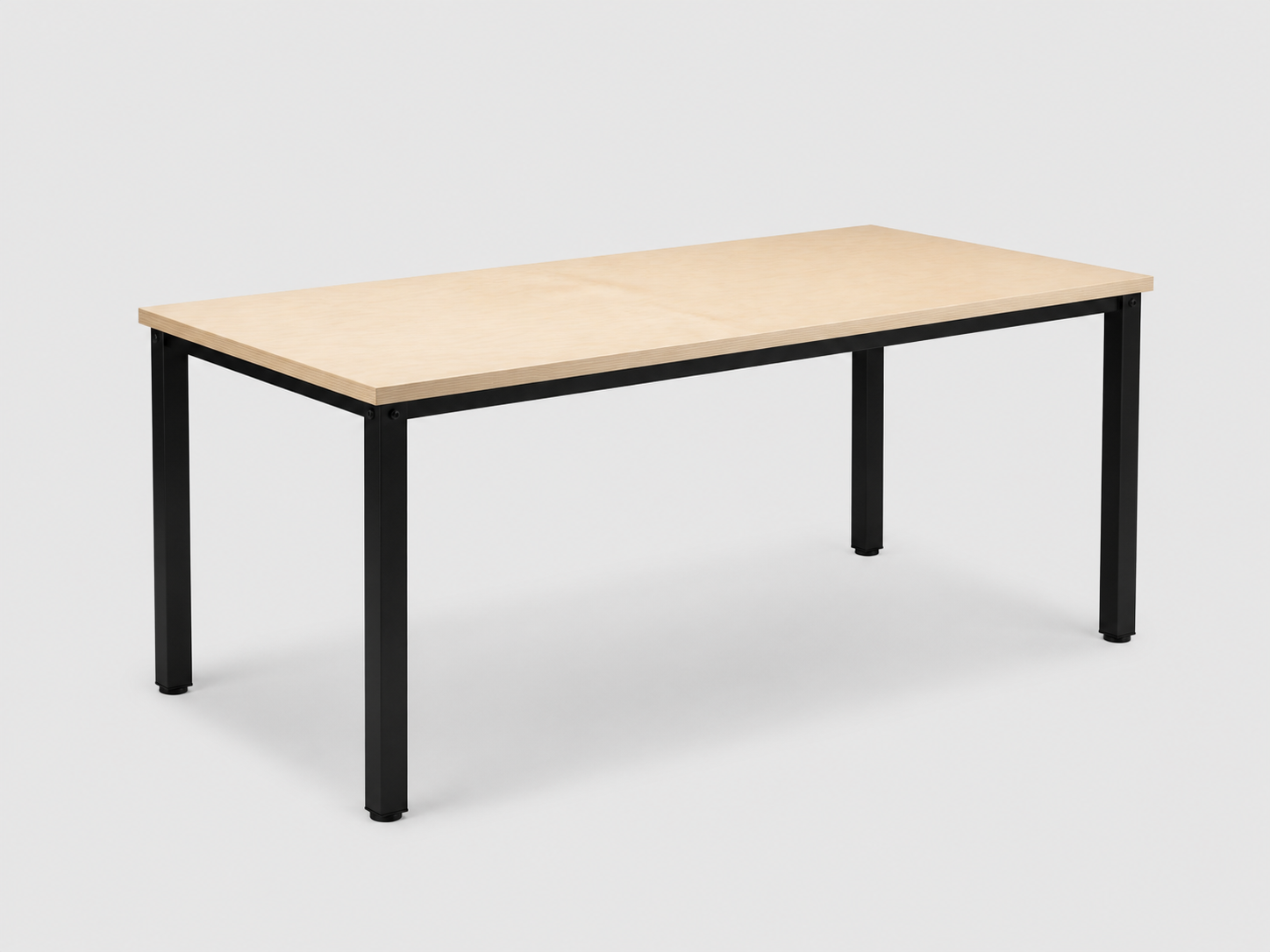
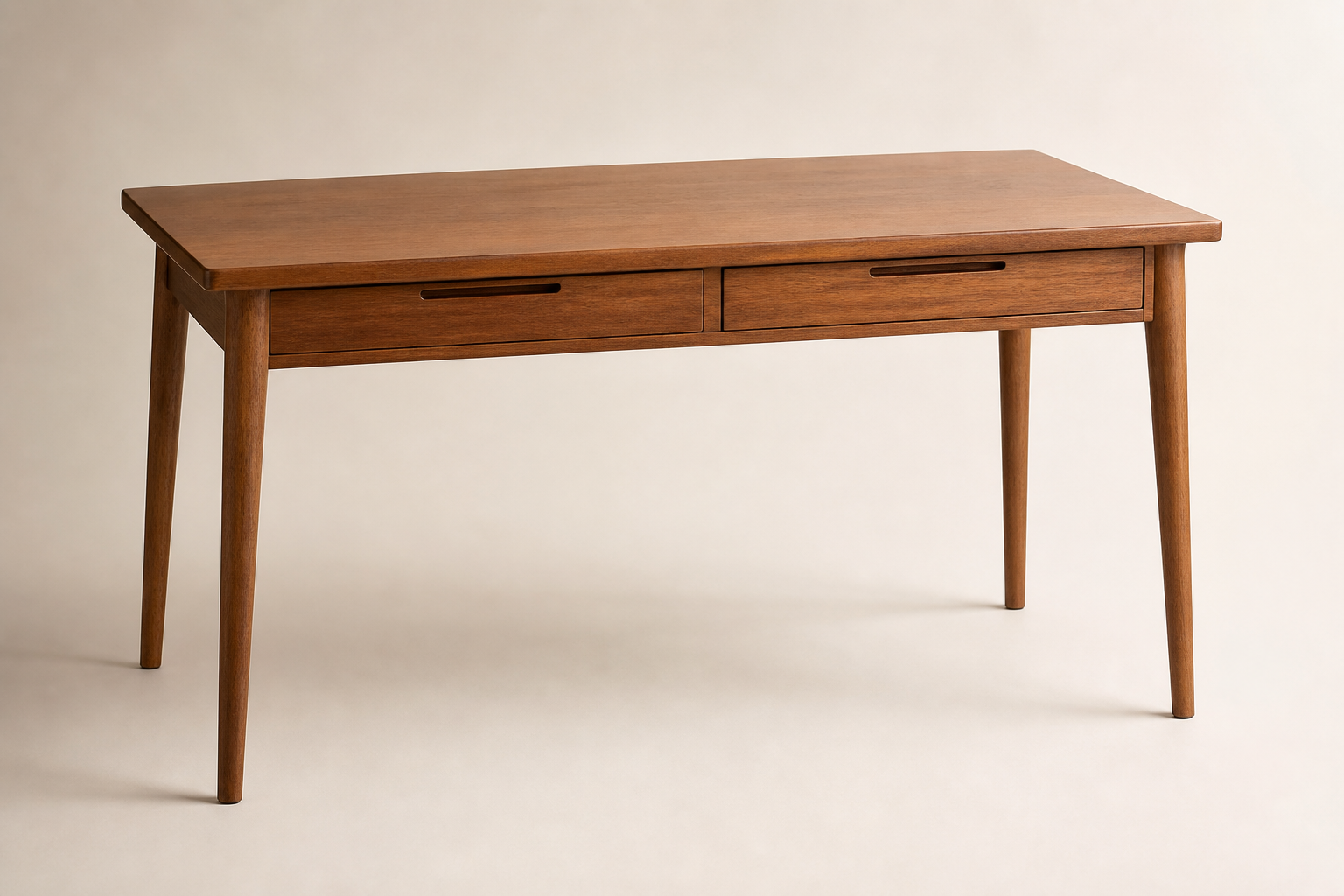
A traditional writing desk is usually the best choice for journaling, paying bills, studying, or working from a laptop. Its simple top and four-leg construction keep visual weight low, which is helpful in a room intended for sleep. A model around 40 inches wide can hold a laptop, notebook, and small lamp without dominating the room. However, minimalist writing desks often provide little storage and may not be deep enough for a large monitor.
A compact computer desk is more suitable if you work in the bedroom every day. Look for a surface at least 22–24 inches deep, a strong frame, and enough width to position a monitor without crowding your keyboard and documents. A rear cable opening or built-in cable tray can prevent chargers from trailing across the floor. Avoid desks with fixed monitor shelves unless the listed shelf height and viewing position fit your equipment; an incorrectly placed riser may force you to tilt your head upward.
Wall-mounted and ladder desks can save floor area, but they introduce different tradeoffs. A wall-mounted desk must be secured to appropriate framing or approved anchors, and its capacity depends on both the hardware and the wall construction. Ladder desks need a stable wall connection so they cannot shift or tip. Neither is ideal when renters are prohibited from drilling or when the wall condition is uncertain. In those cases, a narrow freestanding desk with a stable, well-braced base is the safer and more adaptable option.
Compare the Best Bedroom Desk Formats
| Desk format | Best for | Useful size range | Main advantage | Main drawback |
|---|---|---|---|---|
| Compact writing desk | Journaling and occasional laptop use | 32–42 in. wide | Visually light and easy to place | Limited depth and storage |
| Standard writing desk | Study and mixed daily tasks | 42–54 in. wide | Flexible surface area | Requires more wall space |
| Small computer desk | Daily remote work | 40–55 in. wide, 22–28 in. deep | Better equipment capacity | Can make a bedroom feel like an office |
| Secretary desk | Work that must disappear after use | 30–45 in. wide | Conceals supplies behind a closing front | Limited legroom on some designs |
| Ladder desk | Small rooms with vertical storage | 24–36 in. wide | Uses wall height efficiently | Must be anchored correctly |
| Wall-mounted desk | Extremely limited floor area | 28–48 in. wide | Leaves the floor visually open | Installation and weight limits matter |
| Corner desk | An unused bedroom corner | Varies widely | Makes use of awkward space | Can be difficult to move or reconfigure |
For most buyers, a compact or standard writing desk is the safest starting point. These formats are widely available, straightforward to assemble, and easy to reuse in another room. A secretary desk is particularly useful when work materials create visual clutter: closing the front can help restore a calmer bedroom atmosphere at the end of the day. Check that the open writing surface has adequate support and that the closure hardware cannot fall unexpectedly.
Corner and wall-mounted desks solve specific layout problems rather than serving as universal upgrades. A corner desk can provide generous surface area, but its shape may consume more usable floor space than expected. A wall-mounted model can look elegant in listing photos, yet installation quality becomes part of the product’s safety and performance. Choose these formats only after confirming the room measurements, wall type, equipment load, and long-term layout.
Prioritize Comfortable Working Dimensions
Standard desk height is commonly around 29–30 inches, but that does not mean every desk will fit every user. When seated, your shoulders should remain relaxed, your elbows should be near a right angle, and your wrists should not bend sharply upward to reach the keyboard. If the desk is slightly high, an adjustable chair and footrest may correct the relationship. If it is too low, desk risers may help only when they are stable, load-rated, and compatible with the legs.
Legroom is just as important as top dimensions. Decorative crossbars, deep drawers, and low aprons can reduce clearance under an otherwise spacious desk. Review the measurement from the floor to the lowest obstruction and compare it with your seated knee height. Also check the clear width between the legs. Product listings that provide only overall dimensions may conceal a narrow usable opening, particularly on desks with drawer cabinets or angled supports.
Monitor placement requires additional depth. Ideally, you should be able to view the screen without leaning forward or placing it so close that the surface feels crowded. A shallow desk may still work with a compact laptop, a slim monitor arm, or a wall-mounted display, but those solutions require compatible hardware and safe installation. Do not clamp a monitor arm to a hollow, glass, or thin composite top unless the manufacturer specifically permits it and the desk’s load rating can support the concentrated force.
Examine Materials, Stability, and Weight Capacity
Solid wood can be durable and repairable, but it is often heavier and more expensive than veneered or engineered alternatives. Wood veneer over a stable core can offer a convincing natural appearance at a lower cost, provided edges and seams are well finished. Laminate desks are practical for frequent use because they resist many everyday marks, although damaged edges can be difficult to restore. Powder-coated steel frames often improve rigidity, but thin metal legs without effective bracing may still wobble.
Look beyond broad labels such as “wood” or “metal.” Read the full material description, inspect close-up images of the underside, and check how the legs attach. Bolted corner brackets, cross braces, and substantial aprons generally provide better resistance to side-to-side movement than a top attached to four slender legs with minimal support. Customer reviews can help identify recurring wobble or misaligned holes, but give more weight to repeated, specific observations than to a single unexplained rating.
Never assume a desk can support heavy equipment merely because the top looks thick. Check the manufacturer’s stated total and distributed weight capacities, including separate limits for shelves, drawers, and keyboard trays. A desktop computer, monitor arm, books, printer, and storage boxes can create a substantial combined load. Concentrated loads near an unsupported edge are particularly demanding. If no capacity is published, ask the retailer or choose a better-documented product rather than treating appearance as proof of strength.
Plan Storage, Lighting, and Cable Control
Storage should reflect the work you actually do. One shallow drawer can contain pens, chargers, and a notebook without adding much visual bulk. Deep drawer units provide more capacity but reduce legroom and make the desk harder to move. Open shelves are convenient, yet they also keep work materials visible from the bed. In a small bedroom, a desk with modest closed storage—or a separate rolling cabinet that can be repositioned—often offers more flexibility than an integrated pedestal.
Bedroom task lighting should illuminate the work surface without producing glare on a screen or harsh light across the room. A compact adjustable lamp is usually more useful than a decorative lamp with a fixed shade. Check that its base will not consume too much desk space and that the cord can reach an outlet safely. If you use the desk at night, a focused task light with adjustable brightness can support work while keeping the rest of the room comparatively subdued.
Use a mounted cable tray, reusable ties, or adhesive cable clips approved for the relevant surface. Keep power strips off bedding, away from curtains, and where ventilation is not obstructed. Do not run extension cords beneath rugs or pinch them behind furniture. If the only outlet is across a walking route, rearrange the desk or consult a qualified electrician about a better outlet location rather than creating a trip or fire hazard with a permanently stretched cord.
Check Bedroom Safety Before You Buy
A freestanding writing desk is usually less prone to tip-over than a tall bookcase, but stability still matters. Place it on a level floor, tighten all hardware after assembly, and use any manufacturer-supplied wall restraint. Desks with tall hutches, stacked shelving, or a secretary-style upper cabinet should be treated as tip-over risks. Secure adjacent dressers and bookshelves as well, especially in homes with children, and never rely on drywall alone when the anchoring instructions require a wall stud.
Choose only load-rated shelves and distribute heavy books close to supported areas rather than along a weak front edge. Do not let children climb drawers, shelves, or crossbars. Sharp desk corners can be protected with securely fitted corner guards, but guards are a supplement rather than a substitute for sensible placement and supervision. Avoid locating a sharp corner directly beside a bed exit or in a narrow nighttime route.
New furniture may release odors or volatile organic compounds from finishes, adhesives, or composite panels. Assemble and air out the desk in a well-ventilated space when possible, follow the manufacturer’s care instructions, and stop using it if odors cause persistent irritation. If the bedroom also contains an upholstered desk chair or bench, review applicable fire-safety labeling and keep it away from heaters, candles, overloaded outlets, and damaged charging cables. Do not apply an unapproved “fireproofing” spray; such products can change the fabric or introduce additional chemicals without making the item reliably safe.
Evaluate Online Listings and Total Cost
A useful product listing should provide assembled dimensions, internal clearances, materials, weight capacity, package weight, assembly requirements, and warranty information. Compare these details across retailers because marketplace titles and photographs can be inconsistent. Dimensions shown in a diagram are generally more useful than room-scene images, which may use wide-angle photography or digitally staged proportions. Save a copy or screenshot of the specifications you relied on in case the listing changes.
Budget for more than the desk itself. A low-cost flat-pack model may also require a chair, task lamp, cable tray, footrest, wall anchors, and delivery surcharge. A more expensive desk that includes effective storage and a stable frame may be better value than a cheaper unit that needs immediate accessories or replacement. Conversely, built-in <a href="/products/ikea-nymane-work-lamp-wireless-charging-white/" class="product-inline-link">wireless charging</a>, USB ports, and motorized features are poor investments if they complicate repairs and do not support your actual routine.
Return terms are especially important for furniture bought online. Confirm whether the retailer accepts returns after assembly, who pays return shipping, and whether the item must be repacked in its original carton. Freight returns can be expensive. Inspect all panels and hardware before beginning assembly, photograph any damage, and pause if holes are missing or parts are visibly distorted. Forcing mismatched components can damage the desk and make a legitimate return more difficult.
Avoid Common Bedroom Desk Buying Mistakes
The most common mistake is selecting the largest desk that technically fits. A bedroom needs breathing room, not merely enough square footage to contain furniture. If the chair blocks a dresser or the desk narrows the path to the bed, daily use will be frustrating. Another mistake is choosing an extremely shallow desk for a full-time computer setup. It may look discreet when empty but become crowded as soon as a monitor, keyboard, lamp, and notebook are added.
Do not confuse drawers with useful storage. A center drawer can press against your thighs, while a deep side cabinet can shift the chair away from the monitor. Likewise, decorative trestle legs may interfere with feet, and a lower support bar may prevent a chair from tucking under the top. Examine underside photographs and dimension drawings before buying. If these are unavailable, ask for measurements rather than assuming the obstruction is minor.
Finally, do not improvise structural modifications to compensate for a poor purchase. Drilling into a glass top, cutting load-bearing braces, stacking a desk on unstable blocks, or mounting heavy shelves with unsuitable anchors can cause serious failure. If a desk cannot safely accommodate your equipment or body position within the manufacturer’s instructions, return or replace it. A bedroom workspace should be easy to live with, not an ongoing repair experiment.
Know When Professional Help Is Worthwhile
Most flat-pack writing desks can be assembled by a careful adult who follows the instructions and uses the specified tools. Professional assembly becomes sensible when the desk is unusually heavy, incorporates a large hutch, requires precise wall mounting, or cannot be safely lifted by the available people. It is also worth considering when flooring is uneven and the product lacks an approved leveling method.
Call a qualified installer when wall construction is uncertain, especially for floating desks or heavily loaded shelving. A professional can identify studs or suitable masonry fixings and determine whether pipes or electrical cables may be concealed behind the proposed mounting area. Renters should also obtain written landlord approval before making substantial holes or permanent alterations. Do not guess at anchor capacity based only on package marketing.
Electrical work belongs with a licensed electrician. If the layout would require permanent extension cords, overloaded outlets, damaged receptacles, or routing cables through walls, stop and seek professional advice. Similarly, discontinue assembly if structural parts are cracked, threaded inserts pull out, or the frame remains unstable after being tightened according to the manual. Adding random screws or glue may hide the symptom without restoring the engineered capacity.
Frequently Asked Questions
The following questions address the decisions that most often determine whether a bedroom desk remains useful after the initial setup. Exact requirements vary with body size, equipment, and room layout, so treat general dimensions as a starting point and verify them against your own measurements.
When comparing products, prioritize clear specifications and safe installation over feature-heavy marketing. A desk that fits your chair, equipment, and movement routes is usually a better purchase than a fashionable model with charging ports or shelving you will not use.
What size writing desk is best for a small bedroom?
A desk approximately 36–42 inches wide and 18–22 inches deep can suit occasional laptop work, writing, and household administration. Daily monitor use is generally more comfortable with a depth closer to 24 inches. Tape the footprint to the floor and include chair clearance before deciding.
Is a desk in the bedroom bad for sleep?
Not automatically, but visible work can make it harder to separate working time from rest. Keep the surface orderly, use closed storage where practical, and shut down or remove work devices at the end of the day. A secretary desk can help because its work surface closes when not in use.
Should a bedroom desk face the wall or the window?
Facing a wall often simplifies cable control and limits visual distraction. Facing a window can provide pleasant daylight, but direct sun may cause screen glare or heat. A position perpendicular to the window is frequently a useful compromise. Avoid blocking required ventilation, radiator clearance, or emergency access.
Can I use a console table as a writing desk?
A console may work for brief handwriting or laptop sessions, but many are too shallow, high, or structurally light for sustained use. Verify its height, legroom, top depth, and weight capacity. Do not attach a monitor arm or load it with equipment unless the manufacturer confirms that use.
How much should I spend on a bedroom writing desk?
Price should reflect construction, stability, materials, and expected use rather than appearance alone. An occasional-use desk can be simple, while a daily workstation justifies spending more on a rigid frame and appropriate dimensions. Compare the total cost after adding storage, lighting, cable management, delivery, and assembly.