Hunting note
Start with the decision, then inspect the details.
A practical guide for homeowners and renters researching furniture purchases online on best marble side table affordable, covering the best next steps, tradeoffs, and when to call a pro.
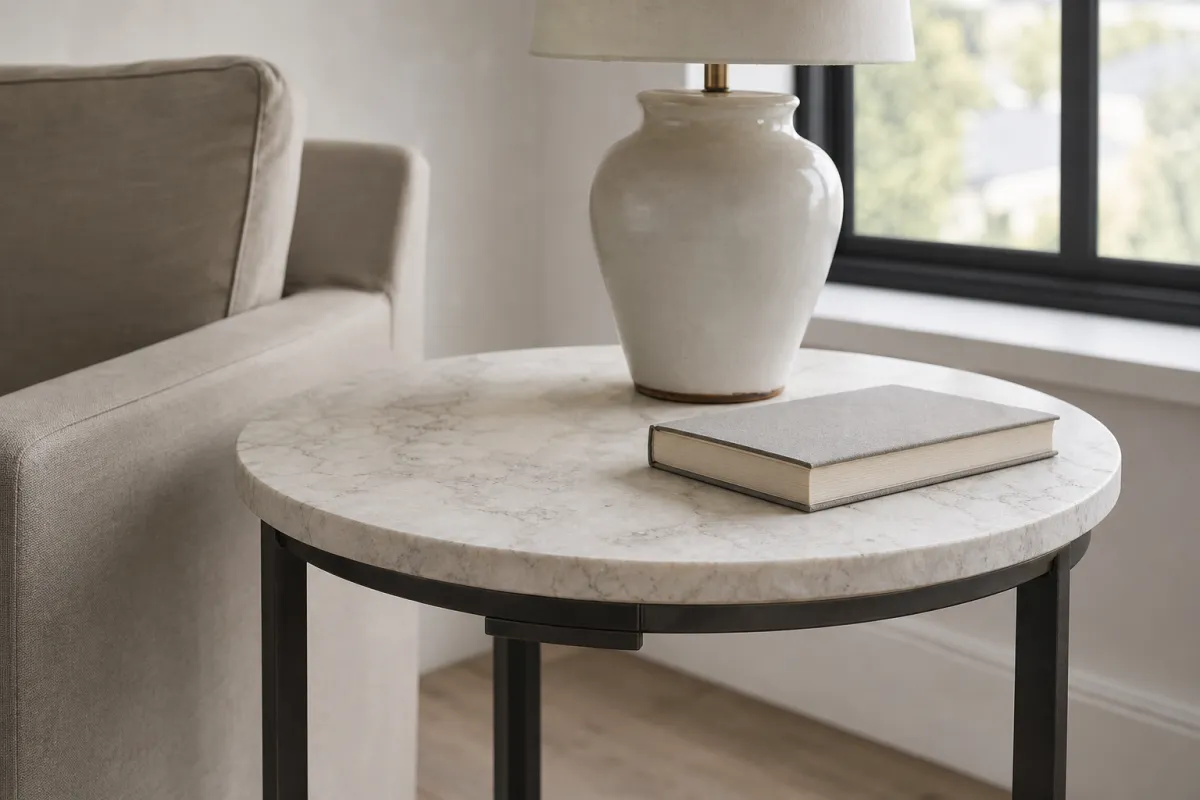
Finding the best marble <a href="/products/article-fiore-side-table-walnut/" class="product-inline-link">side table</a> at an affordable price starts with deciding what “marble” needs to mean in your room. Genuine stone offers unique veining, weight, and longevity, but it can stain, etch, chip, and cost more to ship. Marble veneer reduces weight and price while retaining a real-stone surface. Sintered stone, quartz composite, porcelain, and convincing printed finishes can be more practical for renters or busy rooms, provided the listing describes them honestly.
Do not shop by a glamorous image or low price alone. Verify materials, dimensions, weight, construction, care requirements, return costs, and load rating before comparing styles.
Define affordable by total cost, not list price
An affordable table is one that fits the budget after delivery, assembly, protection, and likely maintenance. A heavy stone table advertised cheaply may carry substantial freight or return fees. A bargain marketplace listing may require you to buy felt pads, sealer, or replacement hardware. Conversely, a moderately priced table with included delivery and a useful warranty can cost less overall.
Set a ceiling, then reserve part of it for contingencies. Compare delivered prices on the same day because promotions and shipping terms change. For genuine stone, inspect the return policy for natural variation; many sellers do not treat veining differences as defects. If the table arrives chipped or structurally unsafe, document packaging and damage immediately rather than assembling it and weakening a claim.
Understand real marble, veneer, and marble-look materials
Solid-marble tops are cut from stone, although “solid” does not mean indestructible. They feel cool, have veining that continues with natural irregularity, and are relatively heavy. Marble veneer uses a thin stone layer bonded to a substrate, lowering weight and cost. Ask what supports the veneer and how edges are finished, since moisture can affect some cores if seams fail.
Engineered quartz, sintered stone, and porcelain may deliver consistent pattern, lower porosity, and easier care, though performance varies by product. Printed laminate or foil over fiberboard is usually the least expensive and lightest; it can look good at normal distance but may show repetitive veining or vulnerable edges. “Faux marble” is not automatically poor quality—ambiguity is the problem. A responsible listing names the surface and core clearly.
Measure the room and choose useful proportions
A <a href="/products/article-sporo-travertine-side-table-walnut/" class="product-inline-link">side table</a> should relate to the seat beside it. A top near the sofa or chair arm height is usually easiest for setting down a drink, while an unusually low table may look elegant but function poorly. Measure available width and depth with the seat in normal position, then preserve a comfortable circulation path. Use painter’s tape or a cardboard template to test the footprint.
Small round tops soften tight passages and eliminate sharp stone corners, while square tables maximize surface area against a straight sofa arm. Consider the <a href="/products/artemide-tolomeo-classic-table-lamp-aluminum/" class="product-inline-link">lamp base</a>, cup, remote, and book you expect to place there. A delicate pedestal can leave more visual space but may be less stable than a broad base or four-leg frame. Check product dimensions rather than judging scale from staged photos.
Evaluate the base and attachment points
A beautiful top is only as useful as its support. Powder-coated steel is common and economical, but weld quality and leveling feet matter. Wood adds warmth but must be adequately braced. A pedestal should have enough base area and weight to resist tipping. Review underside photos for mounting plates, threaded inserts, brackets, and whether screws enter stone directly or a bonded support panel.
Look for an explicit maximum load and follow it. Side tables are not stools or step platforms. If reviews mention wobble, determine whether the cause is uneven floors, poor assembly, or flexible construction. Adjustable feet can solve minor floor variation; improvised shims or overtightened fasteners can create other problems. For stone tops, overtightening may concentrate stress, so use the manufacturer’s sequence and torque guidance.
Compare options with a practical buying table
| Material | Main advantage | Main tradeoff | Good fit for |
|---|---|---|---|
| Genuine marble | Unique natural surface | Stains, etching, weight | Careful adult spaces |
| Marble veneer | Real stone at lower weight | Edge and core vulnerability | Moderate-use rooms |
| Sintered stone/porcelain | Durable, consistent surface | Less natural depth | Busy households |
| Quartz composite | Lower porosity, uniformity | Heat and chemical limits vary | Easy-care priorities |
| Printed laminate | Lowest cost, lightweight | Edge wear, less realism | Renters and temporary use |
Read the exact specification because retailers use category names loosely. Confirm whether dimensions include the base, whether stone thickness is total slab thickness or a built-up edge, and whether assembly tools are included. Save the listing and care guide at purchase in case the product page later changes.
The best value may also be secondhand. Local pickup avoids shipping and lets you inspect the top, but only move heavy stone with sufficient help and a suitable vehicle. Never lift a table by an unsupported marble top; follow safe handling guidance.
Inspect photographs, samples, and reviews critically
Zoom in on edges, corners, and underside connections rather than only the hero photograph. Genuine marble varies, so exact pattern matching is unrealistic, but repaired cracks, mesh backing, resin fill, and surface pits should be disclosed where relevant. In marble-look products, inspect whether the pattern wraps convincingly over edges and whether seams align.
Reviews are most useful when they describe measurements, packaging, assembly, stability, and long-term surface behavior. Treat isolated claims cautiously and look for repeated patterns. Customer photos can reveal scale and color, but phone white balance alters warm and cool tones. If coordinating with existing stone, obtain a swatch where possible; trying to make two nearly matching marbles look identical often works less well than choosing a deliberate contrast.
Choose a finish you can realistically maintain
Polished marble reflects light and displays color strongly, but acid etching can leave dull spots. Honed marble has a softer matte appearance and may make etching less visually abrupt, though it still stains. Sealer can slow absorption on suitable stone; it does not make marble acid-proof or maintenance-free. Follow the table maker’s product recommendations rather than applying a random coating.
Use coasters, wipe spills promptly, and clean with a soft cloth and a pH-appropriate cleaner. Vinegar, lemon, abrasive powders, and harsh bathroom products can damage calcium-based stone. Protect floors with non-staining pads. Printed and engineered surfaces have their own restrictions, including heat and solvent limits, so “easy care” still requires reading instructions.
Match style without chasing a short-lived trend
A simple stone top on a restrained metal or wood base adapts more easily than an ornate shape tied to one trend. White marble with gray veining feels crisp; cream or beige stone pairs naturally with warm woods; dark marble provides drama but shows dust and water marks differently. The table need not match a <a href="/products/article-amoeba-42-5-coffee-table-walnut/" class="product-inline-link">coffee table</a>. Repeating one feature—base finish, edge shape, or undertone—usually creates enough connection.
Scale determines whether the design feels refined. A tiny top beside a large sectional can look incidental, while a bulky cube can crowd an apartment. In a visually busy room, choose calmer veining. In a simple room, expressive stone can act as an object of interest. Avoid relying on a pattern so bold that every affordable alternative looks disappointing beside a heavily edited product photo.
Plan for delivery, assembly, and safety
Stone is dense and can injure feet or damage floors if dropped. Check package weight before delivery, clear the route, and arrange adequate lifting help. Wear closed shoes, keep fingers out of pinch points, and assemble on a padded level surface. Do not lean a loose slab upright against a wall. If the instructions call for two people, treat that as a safety requirement.
After assembly, test for rocking without loading the table. Tighten hardware in stages and recheck after initial use. Keep heavy objects centered, protect sharp corners where children use the room, and position the table away from hectic walkways. A top-heavy or visibly unstable product should be removed from use and reported, not “fixed” with adhesive or improvised drilling into stone.
Avoid common bargain-buying mistakes
The most common mistake is assuming “marble” means quarried stone. Another is ignoring return freight on a heavy item. Buyers also underestimate table height, buy a top too small for a lamp, or place porous stone beside a drink-heavy seat without accepting the maintenance. Check all of these before ordering.
Do not use a <a href="/products/article-lenia-storage-side-table-walnut/" class="product-inline-link">side table</a> as extra seating, stand on it, or exceed its load rating. Avoid drilling, enlarging mounting holes, or substituting longer screws that could contact the top. If instructions are missing, hardware does not align, or the slab is cracked, contact the seller. A low price is not a reason to accept structural uncertainty.
Know when to use a specialist
A stone fabricator can assess a valuable chipped slab, confirm whether a stain or etch is treatable, and recommend a compatible sealer. Professional repair is rarely economical for the cheapest faux table, but it may preserve a quality vintage or solid-stone piece. Furniture repair specialists can also address a sound top paired with a failed base.
Use professional movers for exceptionally heavy pieces, stairs, narrow turns, or high-value stone. If a wall-mounted companion shelf or light will be installed nearby, choose anchors based on wall type and rated load; uncertain wiring or hardwired lighting belongs to a qualified electrician. The table itself should remain freestanding unless designed and documented otherwise.
Frequently asked questions
Is faux marble worth buying?
Yes, when the material is clearly disclosed, construction is stable, and its care requirements fit your use. It can be more practical than natural stone.
How can I tell whether a listing is real marble?
Look for explicit material and core specifications, product weight, close edge photos, care guidance, and seller confirmation. Pattern alone is not proof.
Does marble need sealing?
Some natural marble benefits from a compatible penetrating sealer, but follow the manufacturer’s guidance. Sealer does not prevent acid etching.
What height should a <a href="/products/article-gambit-side-table-walnut/" class="product-inline-link">side table</a> be?
Near the adjacent seat’s arm height is generally convenient, but test the relationship with the actual chair or sofa and intended objects.
Are round marble tables safer in small rooms?
They remove sharp corners and can ease circulation, but stability, base projection, and overall weight still need evaluation.