Hunting note
Start with the decision, then inspect the details.
A practical guide for homeowners and renters researching furniture purchases online on best round dining table modern, covering the best next steps, tradeoffs, and when to call a pro.
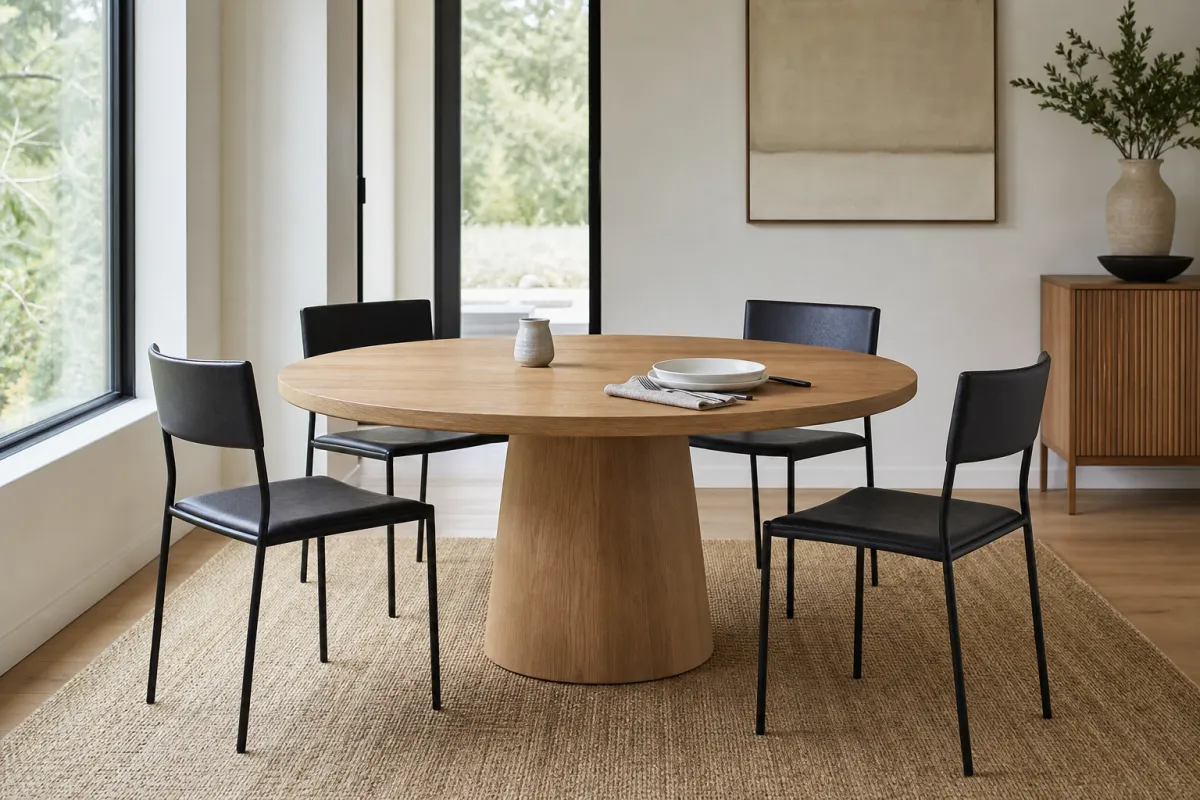
The best modern round <a href="/products/article-conan-75-oval-dining-table-walnut/" class="product-inline-link">dining table</a> is not simply the most attractive one in a product grid. It must fit the room with chairs pulled out, seat the household comfortably, support the expected load, and use a base that does not fight for legroom. For many compact dining areas, a round top around 42 to 48 inches suits four people; larger groups usually need more diameter, and once a round table becomes very large, conversation and serving reach become less convenient.
Measure the complete dining zone before shopping. Shape solves some circulation problems, but it cannot compensate for a table that overwhelms the available floor area.
Measure the room with chairs in use
Record the room’s narrowest dimensions, then mark the proposed table diameter on the floor with painter’s tape. Add the depth of the dining chairs and enough clearance to pull them out and walk behind them. A commonly useful planning range is roughly 36 inches from table edge to a wall or fixed obstruction, with more where people regularly pass, but accessibility and local conditions may demand additional space.
Test the arrangement at doors, cabinets, radiators, and kitchen traffic routes. Measure from the table edge, not its center, and remember that a pedestal base may project near feet. If the dining area shares an open plan, preserve the main route between rooms. A cardboard circle or taped outline reveals much more than a diameter imagined from a listing.
Select diameter from real seating needs
A compact table can seat more people occasionally than it does comfortably every day, but marketing photos often conceal tight elbow room. Place settings, serving dishes, chair width, and pedestal design all affect capacity. Four slim armless chairs fit differently from four broad upholstered chairs. Compare the circumference available per person rather than relying solely on a seller’s seat count.
If the household usually seats two to four and only occasionally hosts six, consider an extension round table rather than permanently crowding the room. Butterfly or stored leaves can turn a circle into an oval, preserving everyday circulation. Verify where leaves are stored, how heavy they are, and whether the extended base remains stable. A mechanism that is too awkward to use offers little practical value.
Compare pedestal, four-leg, and trestle bases
A central pedestal is popular because it reduces conflicts between chair legs and table legs. The tradeoff is stability: a narrow or lightweight base beneath a wide top can rock or tip if someone leans heavily on the edge. Look for a broad footprint, substantial attachment plate, clear load guidance, and reviews that discuss movement after months of use. Sculptural pedestals may also reduce knee room.
Four-leg tables distribute load predictably but can restrict chair placement, particularly on smaller rounds. Splayed legs may create more visual energy while projecting into circulation. Some modern tables use three legs or a compact trestle; inspect underside dimensions and compare them with chair width. Never assume a dramatic base is functional because staged chairs appear tucked beneath it.
Choose a top material for the way you live
Solid wood can be repaired and ages attractively, but it responds to humidity and requires appropriate cleaning. Veneered wood offers visual consistency and efficient material use, though sanding options are limited. Glass makes a small room feel open but shows fingerprints and needs tempered construction and careful edge inspection. Stone and ceramic offer presence and heat resistance that varies by material, but weight, chipping, and delivery become significant.
High-pressure laminate and other engineered surfaces can be excellent for families, renters, and frequent use when edges and substrate are well made. “Modern” does not require fragile materials. Request the precise top construction, finish, cleaning restrictions, and resistance claims. Heat-proof, stain-proof, and scratch-proof are unusually broad promises; use trivets and wipe spills even on durable surfaces.
Use a quick comparison table
| Table type | Strongest benefit | Main tradeoff | Best use |
|---|---|---|---|
| Wood pedestal | Warm, flexible chair placement | Needs stable broad base | Everyday dining |
| Glass four-leg | Visually light | Cleaning and edge care | Small bright rooms |
| Stone pedestal | Durable visual anchor | Very heavy, chip risk | Stable long-term placement |
| Laminate round | Affordable, easy care | Edge quality varies | Busy or rental homes |
| Extension round | Flexible capacity | Mechanism and storage | Occasional hosting |
Use the table to build a shortlist, then check measurements and construction. A stone table may be inappropriate upstairs without a safe delivery route; a glass table may be inconvenient where constant fingerprints are frustrating; a beautiful pedestal may fail if chair arms cannot tuck beneath the apron.
Compare the delivered total, including assembly, room-of-choice service, and return freight. Save specifications and warranty terms. Large furniture returns can be expensive enough to change which option is genuinely best value.
Check ergonomics, apron depth, and chair fit
Standard dining heights cluster within a familiar range, but small differences matter when combined with seat height and an apron. Measure from the floor to the underside of the table at the seating position, not just to the top. Subtract the chair seat height to estimate thigh clearance. Armchairs need to clear the apron if they are expected to tuck in.
Chair shape also affects the visual and physical fit. Curved backs echo a round top, while angular chairs create deliberate contrast. Prioritize stable frames and suitable load ratings over appearance. If buying table and chairs separately, test one chair or build dimensioned templates. A set photograph does not guarantee another chair model will clear a sculptural base.
Judge construction from online listings
Look beyond styled room images. Useful photos show the underside, mounting plate, joinery, extension mechanism, edge profile, and floor contact points. Product weight can indicate substance but does not prove stability. Read assembly instructions before ordering if available; they reveal hardware, required tools, lifting requirements, and whether the top must be inverted.
Reviews are most valuable when they identify wobble, finish wear, packaging, color variation, and assembly alignment. Separate shipping damage from repeat construction faults. For natural wood or stone, expect visual variation, but check how the retailer defines acceptable variation. Confirm whether product dimensions are exact or approximate and whether the base arrives assembled.
Match modern style without making the room generic
Modern round tables range from minimal Scandinavian wood to glossy lacquer, industrial metal, fluted pedestals, and monolithic stone. Start with the room’s fixed features. Warm oak softens white kitchens; dark walnut adds depth; a pale top reduces visual weight; black can create a strong outline. Repeating a finish from nearby lighting or cabinetry helps integration.
Avoid matching every element. A round table can pair with chairs of a different material as long as scale and undertones cooperate. Preserve breathing room around a sculptural base rather than surrounding it with bulky chairs. Trend-driven details are easier to update in lighting, upholstery, and tableware than in a large expensive table, so favor a durable fundamental form.
Plan delivery and assembly before checkout
Measure doorways, elevators, stairs, and turning points, including packaging. Round tops can be awkward even when their diameter fits through a door. Check total package weight and whether the top detaches from the base. Arrange enough lifting help and protect floors. Do not drag a pedestal table by its top because leverage can damage the connection.
Assemble on a padded level surface using the specified hardware. Tighten bolts gradually in a cross pattern where instructed, then place the table upright with adequate help. Never lean a glass or stone top unsecured against a wall. Recheck fasteners after initial use, but do not overtighten inserts. Missing holes, cracks, or misaligned hardware require seller support rather than drilling improvised corrections.
Keep the table stable and safe
Test for rocking before loading the surface. Adjustable levelers can correct minor floor variation; instability caused by a flexible base or loose connection needs proper repair. Follow the maximum load rating and distribute heavy objects near the center. A dining table is not a bench, ladder, or changing platform, and sitting on the edge can create tipping forces even on a heavy base.
Protect sharp edges and monitor top-heavy pedestal designs in homes with children. Keep pathways clear and select chairs that do not project excessively. Glass should be safety glass appropriate for furniture and free of chips. Stone cracks, loose bases, splitting wood, or stripped fasteners are stop-use conditions until professionally assessed.
Avoid common buying mistakes
Do not choose from seat count alone, forget chair pullout space, or assume all pedestals improve legroom. Ignoring apron depth can make an otherwise correctly sized table uncomfortable. Buying an oversized circle because it technically fits often creates a cramped room and makes passing food across the center difficult.
Other mistakes include overlooking return freight, expecting screen colors to be exact, and selecting a delicate finish for an intensive-use kitchen. Do not alter structural hardware to make parts fit. If a table requires wall anchoring despite being marketed as freestanding, or arrives with unclear stability instructions, pause and obtain clarification from the manufacturer.
Know when custom or professional help makes sense
A custom table can be worthwhile for an unusual banquette, a narrow room, or a need for a specific extension mechanism. A furniture maker can balance diameter, base footprint, and top thickness while planning material movement. For valuable vintage tables, use a furniture conservator rather than experimenting with aggressive refinishing.
Professional delivery is sensible for stone, large glass, difficult stairs, or limited lifting ability. An interior designer can verify scale, but a taped floor plan remains useful for every budget. Hardwired lighting relocation above the table must be completed by a licensed electrician; do not stretch cords across circulation routes to center a fixture.
Frequently asked questions
What size round table is best for four people?
About 42 to 48 inches often works, depending on chair width, place settings, base design, and desired elbow room.
Is a pedestal table more stable?
Not automatically. It improves chair flexibility, but stability depends on base width, weight distribution, construction, and top diameter.
Can a round table work in a rectangular room?
Yes, especially when it creates a distinct dining zone. Check circulation at the narrow ends and relationship to nearby furniture.
Is glass good for a small dining room?
It can reduce visual weight, but requires frequent cleaning and verified safety construction. Edge condition and stability remain essential.
Should I buy an extendable round table?
Choose one when hosting needs fluctuate and the mechanism is easy, stable, and compatible with your storage space.